What are Electromagnetic Waves? The Spectrum from Radio to Gamma
Electromagnetic waves are ripples of electric and magnetic energy that travel through space at the speed of light. They make up everything from the radio waves that carry music to your car, to the X-rays that let doctors see inside your body, to the visible light that allows you to read this sentence. Together, all of these waves form the electromagnetic (EM) spectrum — one of the most fundamental concepts in physics and the foundation of modern technology. This article explains what electromagnetic waves are, how they work, and why the spectrum matters in our everyday lives.
What Exactly Is an Electromagnetic Wave?
An electromagnetic wave is a combination of two things: an electric field and a magnetic field that oscillate (vibrate) perpendicular to each other and to the direction the wave travels.
- Electric field: Created by electric charges. It pushes or pulls other charges.
- Magnetic field: Created by moving charges (electric current). It affects other moving charges.
Unlike sound waves (which need air or water to travel), electromagnetic waves do not need a medium. They can travel through the vacuum of space — which is how sunlight reaches Earth.
Key characteristics of all EM waves:
- Wavelength (λ): The distance between two consecutive peaks of the wave. Measured in meters (m), centimeters (cm), or nanometers (nm).
- Frequency (f): How many wave peaks pass a given point per second. Measured in Hertz (Hz).
- Speed (c): All EM waves travel at the same speed in a vacuum — approximately 300,000,000 m/s (the speed of light).
There is an inverse relationship between wavelength and frequency: shorter wavelength = higher frequency, and longer wavelength = lower frequency.
The Electromagnetic Spectrum: A Family of Waves
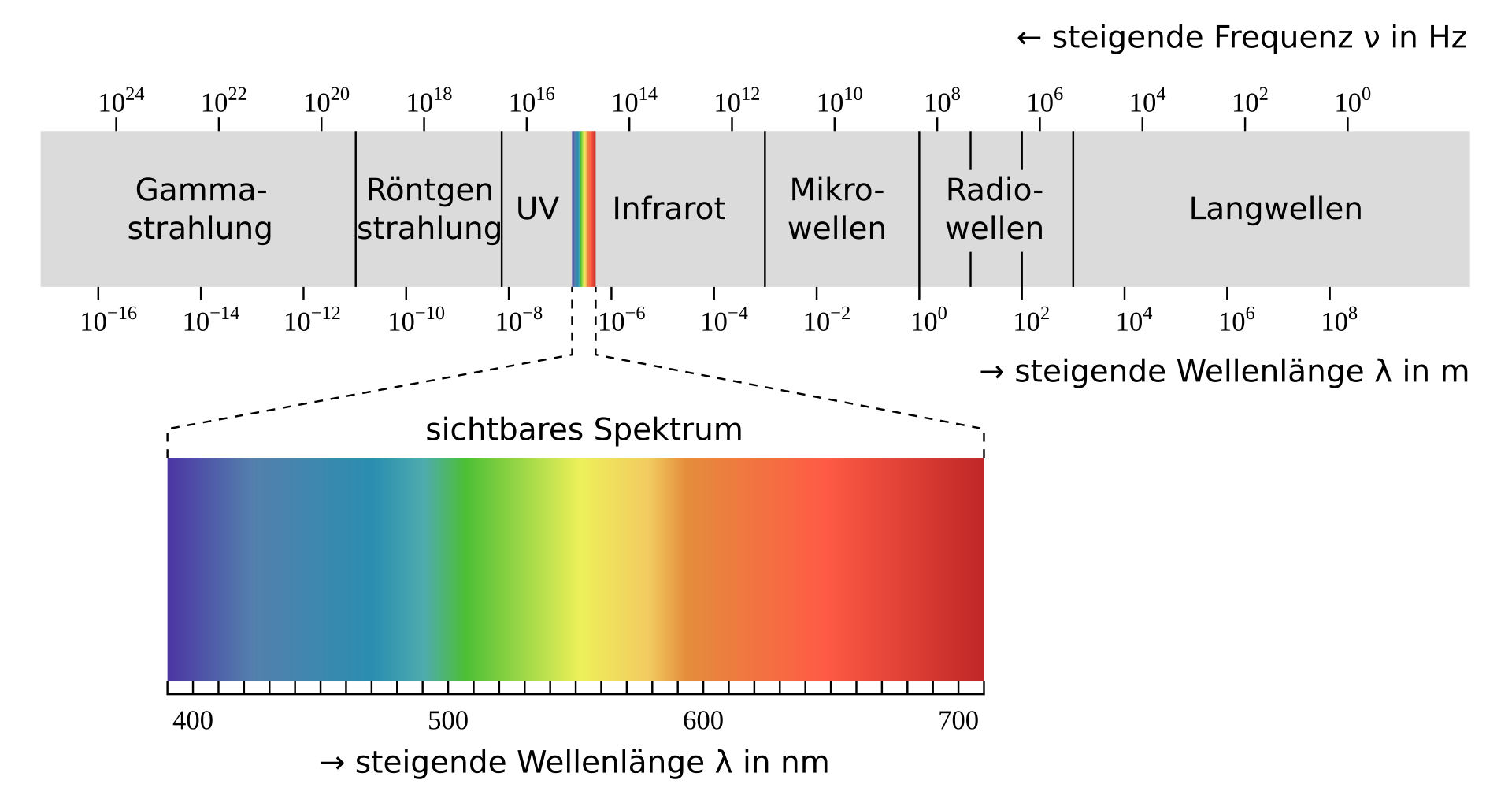
The full range of electromagnetic waves, from the lowest frequency (longest wavelength) to the highest frequency (shortest wavelength), is called the electromagnetic spectrum.
From Radio to Gamma: A Tour of the Spectrum
| Wave Type | Wavelength Range | Frequency Range | Everyday Examples |
|---|---|---|---|
| Radio Waves | > 1 m | < 300 MHz | AM/FM radio, TV, Wi-Fi, Bluetooth, radar |
| Microwaves | 1 mm – 1 m | 300 MHz – 300 GHz | Microwave ovens, GPS, satellite TV, 5G |
| Infrared (IR) | 700 nm – 1 mm | 300 GHz – 430 THz | Remote controls, thermal imaging, night vision |
| Visible Light | 400 – 700 nm | 430 – 770 THz | Everything we see: sunlight, LEDs, lasers |
| Ultraviolet (UV) | 10 – 400 nm | 770 THz – 30 PHz | Sunburn, black lights, sterilization |
| X-Rays | 0.01 – 10 nm | 30 PHz – 30 EHz | Medical imaging, airport security, astronomy |
| Gamma Rays | < 0.01 nm | > 30 EHz | Cancer treatment, nuclear medicine, astrophysics |
Table: The electromagnetic spectrum from the longest to the shortest wavelengths.
How Do We Use Electromagnetic Waves in Everyday Life?
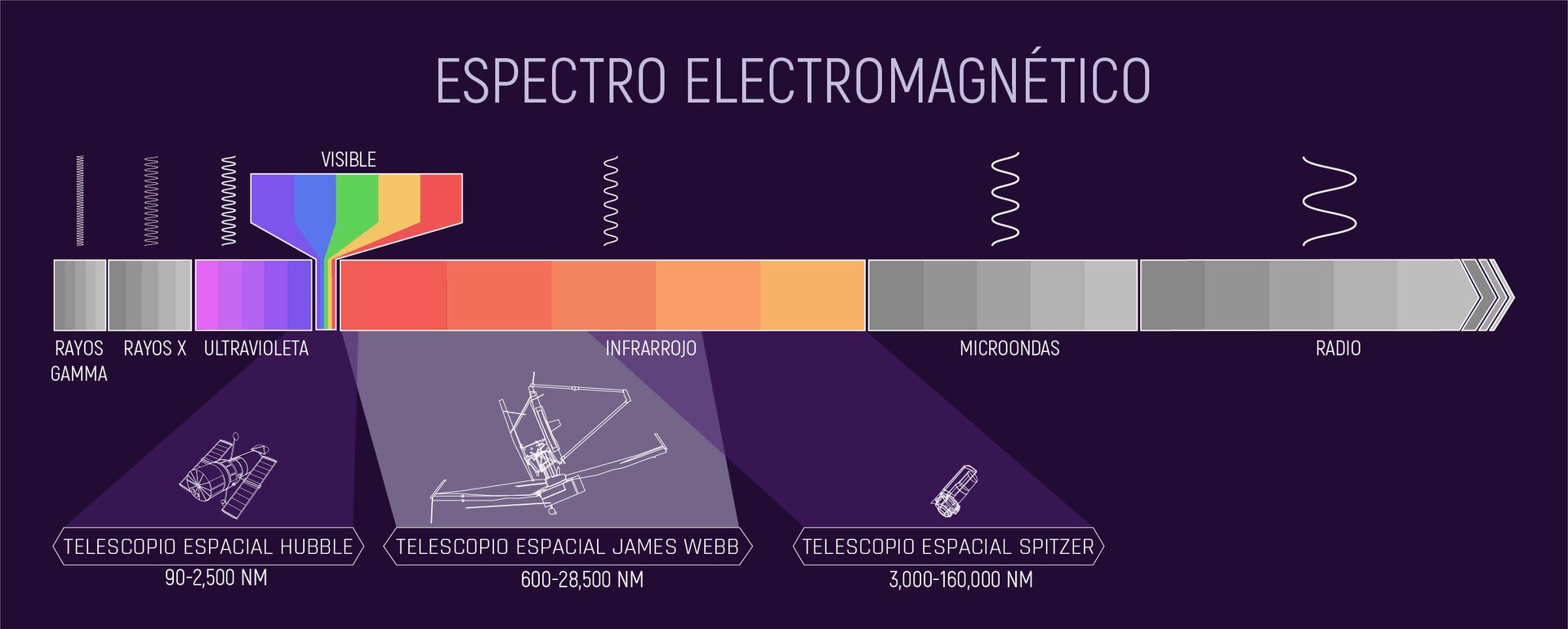
You interact with electromagnetic waves every day, often without realizing it. Here's how each part of the spectrum affects our lives.
- Radio waves carry your favorite music, news, and podcasts through the air. They also make Wi-Fi, Bluetooth, and GPS possible.
- Microwaves heat your food in seconds — and also carry data to your smartphone via cell towers.
- Infrared is felt as heat. It's used in thermal cameras, TV remotes, and even cooking (grills).
- Visible light is the tiny slice of the spectrum that human eyes can detect. It's what lets us see the world, take photos, and read.
- Ultraviolet gives you a tan — but too much causes skin damage. It's also used to sterilize equipment and water.
- X-rays let doctors see bones and teeth without surgery. They're also used in airport security scanners.
- Gamma rays are the most energetic. They're used in cancer treatment (radiotherapy) and to study distant galaxies.
Why Only a Tiny Slice Is Visible
The human eye can only detect a narrow band of the EM spectrum — wavelengths from about 400 to 700 nanometers. This is what we call visible light. Everything else — radio waves, X-rays, infrared — is invisible to us.
That's why technologies like radio telescopes, infrared cameras, and X-ray machines are so important: they let us "see" what our eyes cannot.
Frequently Asked Questions (FAQ)
What is the difference between a radio wave and a gamma ray?
They are fundamentally the same thing — electromagnetic waves. The difference is frequency and wavelength. Radio waves have low frequency and long wavelength. Gamma rays have extremely high frequency and very short wavelength. This difference gives them radically different properties and uses.
Why do EM waves not need a medium?
Unlike sound waves (which require air, water, or solid to vibrate), EM waves are self-propagating. The electric field generates a magnetic field, and the magnetic field generates an electric field — they sustain each other without needing anything else. This is why sunlight can travel through the vacuum of space.
What is the speed of light?
In a vacuum, all electromagnetic waves travel at approximately 300,000 km/s (186,000 miles/s). This is often rounded to 3 × 10⁸ m/s. This is one of the fundamental constants of physics.
How are electromagnetic waves created?
Whenever an electric charge accelerates — or when an electron changes energy levels in an atom — it emits electromagnetic radiation. In a radio antenna, electrons oscillate back and forth, creating radio waves. In the Sun, nuclear fusion creates the full spectrum of EM radiation.
Are electromagnetic waves harmful?
It depends on the type and dose. Low-energy waves (radio, microwave, infrared, visible light) are generally harmless at everyday levels. High-energy waves (UV, X-rays, gamma rays) can damage cells and DNA with enough exposure. This is why we wear sunscreen, use lead aprons during X-rays, and handle radioactive materials with care.
(Conclusion)
The electromagnetic spectrum is far more than a physics concept — it's a window into the universe and the foundation of modern life. From the radio waves that connect us wirelessly to the X-rays that save lives, electromagnetic waves are everywhere. Understanding what they are, how they differ, and how we use them helps us appreciate the invisible forces that power our world — and reminds us that our eyes see only a tiny fraction of the rich spectrum of nature.