What is Electric Current? An Explanation for Beginners
Electric current is the flow of electric charge. In most everyday circuits, this charge is carried by electrons moving through a metal wire. Without current, no device — from a light bulb to a smartphone — can work.
But a flow needs a push. That push is voltage. The relationship between current, voltage and resistance is what makes every electrical device behave in a predictable way.
This article explains what electric current really is, how it differs from voltage, why some materials conduct better than others, and why understanding current matters when you charge a phone or turn on a kettle.
The Core Principle: Moving Charge
Imagine a loop of pipe filled with water. If you do nothing, the water stays still.
- Add a pump (a source of energy), and the water starts moving.
- The amount of water flowing past a point each second is like current.
- The force that the pump applies is like voltage.
In a wire, electrons behave similarly:
- Voltage (V) is the electrical pressure that pushes electrons.
- Current (I) is the number of electrons passing a point every second.
- Resistance (R) is anything that slows them down (narrow wires, poor conductors, etc.).
These three quantities are linked by Ohm’s Law, one of the most important rules in electronics:
Voltage = Current × Resistance → V = I × R
If you increase the voltage, current increases (for the same resistance). If you increase resistance, current decreases (for the same voltage).
What Exactly Flows? The Role of Electrons
In a metal wire like copper, atoms are arranged in a lattice. Each copper atom has one or more free electrons that are not tightly bound. These free electrons drift randomly at high speed.
When you apply a voltage across the wire:
- An electric field forms almost instantly (at the speed of light).
- This field pushes the free electrons in one direction — from the negative terminal toward the positive terminal.
- The drift is surprisingly slow (often millimetres per second), but the effect travels near the speed of light because electrons everywhere in the wire start moving almost simultaneously.
✅ Key idea: Current is the rate of flow of charge, not the speed of individual electrons.
Conventional Current vs. Electron Flow (a Historical Quirk)
Before electrons were discovered, scientists assumed current flowed from positive to negative. That direction is called conventional current and is still used in circuit diagrams.
In reality, electrons (negative charge) flow from negative to positive.
For almost all practical work, you can follow conventional current — your calculations will be correct either way, as long as you are consistent.
How to Measure Current
Current is measured in amperes (amps, symbol A).
A typical LED uses ~0.02 A (20 milliamps). A kettle may use 10–13 A.
To measure current, you must break the circuit and place a multimeter (or ammeter) in series — so all the charge flows through the meter.
⚠ Important: Measuring current is different from measuring voltage (where you place the meter across a component). Wrong connections can blow a fuse or damage the meter.
The table below shows this clearly:
AC vs. DC — Two Ways to Move Charge
Not all current flows in one direction. There are two main types:
- DC (Direct Current): Charge flows in one direction. Batteries, solar cells, and USB power supplies produce DC. Most electronics run on DC internally, even if they plug into an AC wall outlet (they use an adapter or charger).
- AC (Alternating Current): Charge constantly reverses direction — typically 50 or 60 times per second (50/60 Hz). Power stations produce AC because it is easy to transform to high voltage for long‑distance transmission (reducing energy loss). Your wall outlets provide AC.
A simple way to remember:
DC = battery (steady, one way)
AC = wall socket (swings back and forth)
Many modern devices (phone chargers, laptop bricks) convert AC → DC inside the power supply.
Conductors, Insulators and Semiconductors
Why do metals carry current easily, but plastic does not?
- Conductors (copper, aluminium, gold) have many free electrons. They offer low resistance.
- Insulators (rubber, glass, dry wood) keep their electrons tightly bound. They offer very high resistance and are used to coat wires for safety.
- Semiconductors (silicon, germanium) fall in between. Their conductivity can be finely controlled — the basis of diodes, transistors and computer chips.
Resistance depends also on:
- Length (longer wire → more resistance)
- Thickness (thicker wire → less resistance)
- Temperature (for metals: hotter → more resistance)
Real‑World Examples and How to Think About Current
The heating effect of current is useful (kettles, heaters) but also wasteful in long transmission lines. That is why power grids use high voltage — for the same power, higher voltage means lower current, and lower current means less heat loss.
🧠 Gold answer reminder:
Electric current is the flow of charge (usually electrons) driven by voltage through a conductor. It is measured in amperes, obeys Ohm’s law (V = I × R), and can be direct (DC) or alternating (AC).
Frequently Asked Questions (FAQ)
1. Does current flow through a capacitor?
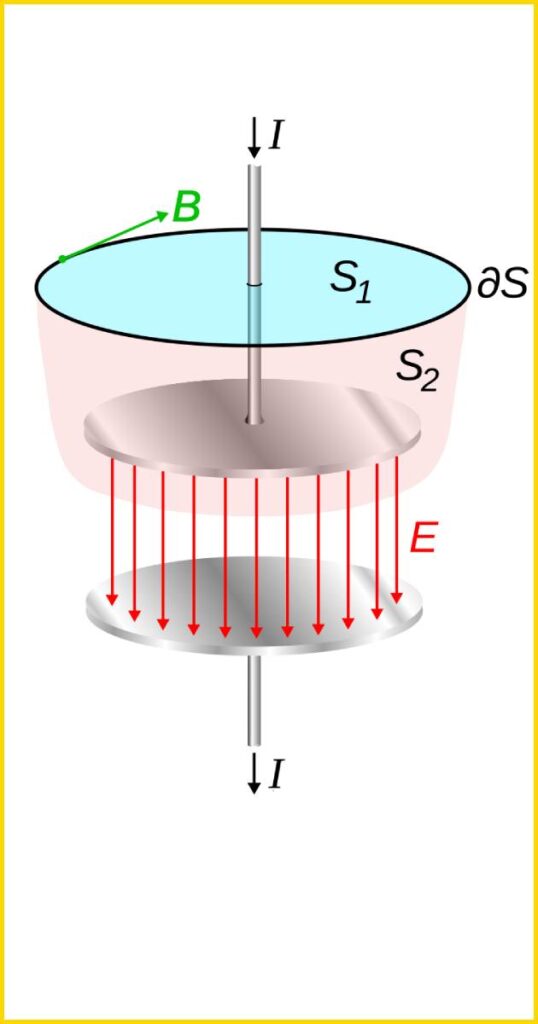
Not a continuous flow of electrons. But a changing voltage appears to push displacement current through the capacitor — which is how AC signals can couple from one stage to another.
2. Can current exist without voltage?
No. Voltage is the cause; current is the effect. Without a potential difference, there is no sustained current (except for brief moments in superconductors, but that still requires an initial voltage to start).
3. Why does a battery eventually run flat?
The chemical reaction that pushes electrons depletes the reactive materials. Less «chemical voltage» means less current can be delivered.
4. Is electric current dangerous?
It is the current through your body that harms you, not simply the voltage. As little as 10–20 mA of AC can cause muscle paralysis (inability to let go). Above ~100 mA may cause heart fibrillation. This is why electrical safety uses insulation, ground‑fault interrupters (GFCIs/RCDs) and low‑voltage designs where possible.
Conclusion
Electric current is the workhorse of every electrical and electronic device. From the tiny currents inside a microchip to the massive currents that start a car engine, the same principles apply: charge moves because a voltage pushes it, and resistance governs how much flows.
Understanding current means understanding the flow itself — not just the speed of electrons, but the rate of charge, the difference between AC and DC, and the role of conductors and insulators.
Once you grasp current, voltage and resistance together, the rest of electronics becomes far easier. Ohm’s law is a small equation, but it opens a very large door.