How Does a Car Engine Work? The 4-Stroke Internal Combustion Cycle
A car engine (internal combustion engine) works by burning a mixture of fuel and air inside a sealed cylinder, harnessing the rapid expansion of hot gases to push a piston, and converting that linear motion into the rotational motion that turns the wheels. This controlled explosion happens hundreds of times per minute in a precise sequence known as the four-stroke cycle. It’s a masterpiece of mechanical engineering that powers most vehicles on the road today. This article will guide you through the core components and the fundamental intake, compression, power, and exhaust strokes that make it all happen.
The Core Principle: Harnessing Controlled Explosions
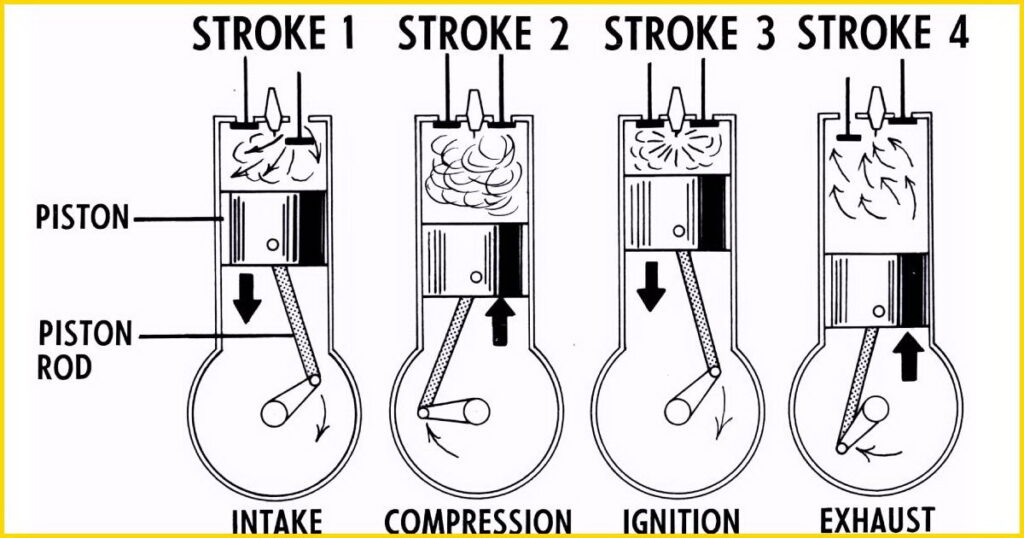
The engine’s goal is to convert the chemical energy locked in gasoline (or diesel) into mechanical energy (motion). It does this not with one big explosion, but with a rapid series of small, perfectly timed explosions inside strong metal cylinders. The force of these explosions is captured by pistons and transformed into useful rotation.
Credit: Pearson Scott Foresman Archives / Wikimedia Commons (Public Domain).
Key Components of a Simple Engine
Before diving into the cycle, let’s meet the main players inside a typical 4-cylinder engine:
- Cylinder: The central, tube-shaped chamber where the piston moves. Engines have multiple cylinders (4, 6, 8, etc.) for smoothness and power.
- Piston: A solid metal plug that fits snugly inside the cylinder. It moves up and down, sealed by piston rings.
- Connecting Rod: Links the piston to the crankshaft, converting up-and-down motion into rotation.
- Crankshaft: The engine’s main rotating shaft. The connecting rods are attached to it at offset points, so the up-down motion of the pistons causes it to spin—like a rider’s legs powering a bicycle crank.
- Cylinder Head: Sits atop the cylinder block, forming the combustion chamber’s top.
- Valves: Intake and exhaust valves are like precise doors that open and close to let air/fuel in and exhaust gases out. They are operated by the camshaft.
- Spark Plug: Creates the electric spark that ignites the fuel-air mixture (in gasoline engines).
- Combustion Chamber: The small space between the top of the piston and the cylinder head where the air-fuel mixture is compressed and ignited.
The Four-Stroke Cycle: A Step-by-Step Journey
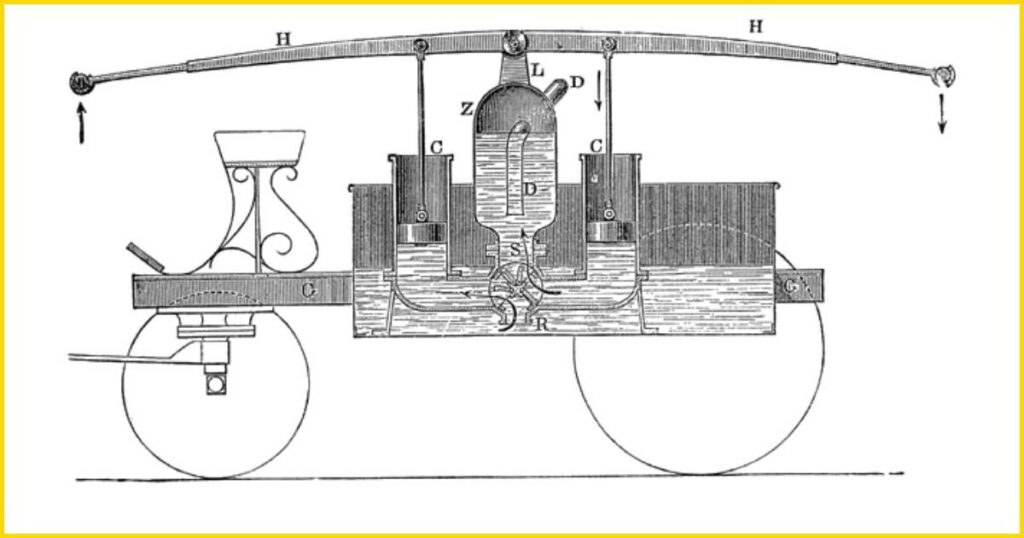
Imagine one cylinder. Here is its complete cycle, which takes two full revolutions (720 degrees) of the crankshaft.
Stroke 1: INTAKE (Piston Goes Down)
- Goal: Fill the cylinder with a fresh charge of air and fuel.
- Process: The intake valve opens. As the piston moves down the cylinder (pulled by the rotating crankshaft), it creates a partial vacuum. This vacuum sucks a mist of atomized gasoline mixed with air (from the fuel injector or carburetor) into the cylinder through the open intake port.
- Analogy: Like a syringe pulling in liquid.
Stroke 2: COMPRESSION (Piston Goes Up)
- Goal: Compress the mixture to make the upcoming explosion more powerful.
- Process: Both the intake and exhaust valves are tightly closed. The piston moves up, compressing the air-fuel mixture into the small volume of the combustion chamber. This compression greatly increases the mixture’s pressure and temperature, making it highly volatile and ready for efficient combustion.
- Analogy: Squeezing a spring to store energy.
Stroke 3: POWER (Piston Goes Down — The «Bang!»)
- Goal: Generate power from combustion.
- Process: At the peak of compression (Top Dead Center — TDC), the spark plug fires, creating a precise spark. The highly compressed fuel-air mixture ignites and burns rapidly, not explodes. This combustion creates a massive increase in pressure from the hot, expanding gases. With all valves still closed, this high-pressure gas forces the piston down with tremendous force. This is the only stroke that produces power; it powers the other three strokes and the car itself. The piston’s downward force turns the crankshaft via the connecting rod.
- Analogy: The squeezed spring being released with extra force.
- Stroke 4: EXHAUST (Piston Goes Up)
- Goal: Expel the burned gases.
- Process: As the piston nears the bottom of its power stroke, the exhaust valve opens. The momentum of the crankshaft and other pistons pushes the piston up again. This upward movement pushes the spent, burned exhaust gases out of the cylinder through the now-open exhaust port and into the exhaust manifold, then out the tailpipe.
- Analogy: A syringe pushing waste out.
The cycle then repeats immediately, starting again with the intake stroke. In a multi-cylinder engine, the pistons are offset so that while one is on its power stroke, others are on different strokes, ensuring smooth and continuous rotation of the crankshaft.
Visualizing the Cycle: A Simple Diagram
Four-Stroke Engine Cycle
How the Four-Stroke Cycle Works
The four-stroke engine completes two crankshaft revolutions per cycle. Each stroke corresponds to one piston movement, with valves opening and closing to control gas flow.
This cycle—Intake, Compression, Power, Exhaust—is the fundamental operating principle of most internal combustion engines.
Gasoline vs. Diesel: A Key Difference
| Feature | Gasoline Engine | Diesel Engine |
|---|---|---|
| Ignition Method | Spark ignition | Compression ignition |
| Power Stroke | Spark ignites mixture | Heat from compression |
| Compression Ratio | Lower (8:1 to 12:1) | Higher (14:1 to 25:1) |
| Fuel Injection | During intake | During compression |
Gasoline vs. Diesel: A Key Difference
The cycle described above is for a gasoline (spark-ignition) engine. A diesel (compression-ignition) engine works on a similar 4-stroke principle but with a crucial difference:
- Intake: Only air is drawn into the cylinder.
- Compression: The air is compressed much more tightly (higher compression ratio), causing it to become extremely hot (over 500°C).
- Power: At the peak of compression, diesel fuel is injected directly into the super-hot air. The heat of the air alone causes the fuel to ignite spontaneously, without a spark plug.
- Exhaust: Same as gasoline.
Frequently Asked Questions (FAQ)
What is «engine displacement» (e.g., 2.0L)?
Displacement is the total volume swept by all the pistons inside their cylinders. A 2.0-liter engine means that if you could fill all cylinders with liquid, they would hold 2.0 liters when the pistons move from bottom to top. Generally, more displacement means more potential power (and fuel consumption).
What does «V6» or «Inline-4» mean?
This describes the engine layout. An Inline-4 (I4) has four cylinders arranged in a single straight line. A V6 has six cylinders arranged in two banks at an angle (forming a «V»), making the engine more compact. There are also flat/boxer engines, V8s, etc.
Why do engines need oil?
Engine oil is the lifeblood. It lubricates moving metal parts (like pistons in cylinders, crankshaft bearings) to prevent friction, wear, and overheating. It also helps clean and cool the engine. Without oil, metal-on-metal contact would quickly destroy the engine (seizure).
What is turbocharging?
A turbocharger is a device that forces more air into the cylinders than the engine could suck in naturally. It uses the energy of the fast-flowing exhaust gases to spin a turbine, which drives a compressor that packs more air into the intake. More air allows more fuel to be burned, creating a more powerful explosion from the same-sized engine («more power from less displacement»).
(Conclusion)
The internal combustion engine, for all its complexity, operates on an elegantly simple four-stroke cycle: suck, squeeze, bang, blow. This continuous loop of intake, compression, power, and exhaust, repeated across multiple cylinders hundreds of times a minute, transforms the microscopic energy in gasoline droplets into the kinetic energy that propels us forward. While the future may belong to electric motors, understanding the mechanical ballet of pistons, valves, and sparks inside a metal block is to understand the defining technology of the 20th century’s transportation revolution. It’s a testament to engineering where precise timing and controlled chaos work in perfect harmony.